

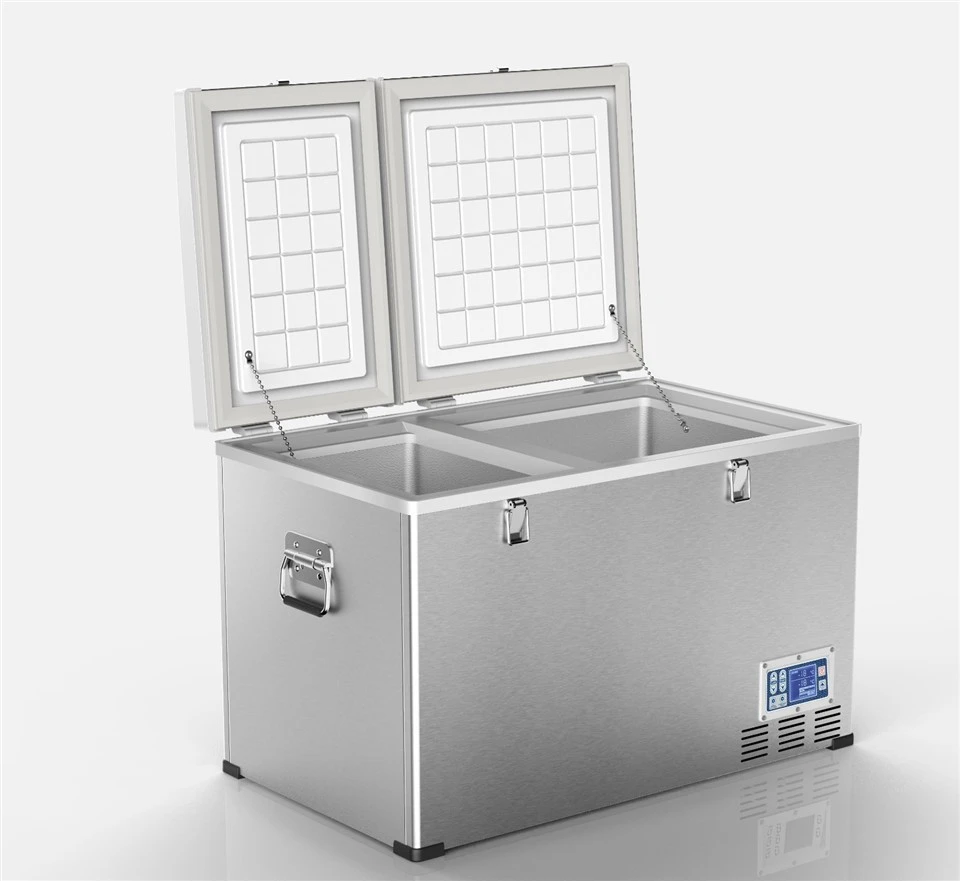
Portable refrigerators are a game-changer for those living off the grid or traveling in vans and RVs. These convenient appliances offer the refrigeration and freezing capabilities of a standard refrigerator, but with the convenience of portability.
If you live in a small home, van, or RV, a small refrigerator is essential for keeping drinks and food fresh on the go!
However, charging a portable refrigerator can be a challenge, especially in remote areas without access to the power grid.
The good news is that you have options. Understanding the best ways to provide reliable power to your refrigerator can optimize its performance and durability while increasing reliability.
Here are some common charging methods to keep your portable refrigerator running smoothly.
Solar Energy
Solar energy is a great way to charge your portable refrigerator.
Whether at home or on the go, using solar energy offers many benefits.
Solar charging provides you with clean, renewable energy, reduces your carbon footprint, and allows you to generate electricity anywhere the sun shines.
Powering your device with solar energy offers a more sustainable, reliable, and convenient way to keep your portable refrigerator running and its contents refrigerated or frozen anywhere the sun shines!
Pros
Solar power can power almost anything-even your entire home!
True energy independence
Easy to transport and store
Clean, renewable energy
Cons
Requires a significant investment
Solar charging can be slower than grid power, depending on the available sunlight.
Battery Charging
Some portable refrigerators run on batteries and can be charged from other batteries. You can purchase plug-in batteries or connect them to your vehicle.
If you're using your car battery to charge your portable refrigerator, look for a 12V power adapter and an AC/DC power connection. You can use a 12V outlet or your vehicle's cigarette lighter. When connected to a 12V cigarette lighter, your portable refrigerator can keep its contents cool using the car battery.
However, once the engine is turned off, power consumption continues, which can drain the battery. To avoid this, consider using a battery isolation switch. You can also consider using an auxiliary battery or deep-cycle batteries.
Portable batteries can offset the potential risk of a dead car battery.
Portable power stations provide a reliable and sustainable energy source that can power a variety of devices, including your portable refrigerator.
Pros
Compatible with a wide range of vehicles
Quiet and compact
Easy to use
Cons
Risk of draining the car battery
Charging time needs to be carefully planned
AC/DC Charging
AC/DC charging allows you to charge your portable refrigerator from anywhere with access to the power grid. If you're camping or driving an RV, you can often use shore power-it's not uncommon to find grid-powered campgrounds.
However, this naturally limits your campsite options, as you'll need to choose one with a working power connection. You'll also incur ongoing costs, as RV parks charge for electricity.
Pros
Convenient and reliable
No portable power source required
Cons
Requires grid access
Campsite electricity costs
Conclusion
Portable refrigerators are useful in a variety of situations.
Whether you're looking to live off-grid, live in a tiny house or RV, or need reliable refrigeration for camping, fishing, or road trips-there's a model for you.
A variety of charging options ensure your belongings stay cold.
You'll soon wonder how you ever lived without a portable refrigerator!
The type of portable refrigerator you choose will also affect the different charging methods.


